

Heskin earns top graduating honours in USask Law
Brad Heskin describes himself as a kid who liked to argue, so it's no surprise he decided early on in life that he wanted to be a lawyer.
By Donella HoffmanHe earned a three-year political studies degree at the University of Saskatchewan (USask) and then successfully applied to the College of Law.
Heskin, born and raised in Yorkton, graduated with his Juris Doctor degree at this year’s USask Spring Convocation on June 3. He also received the Law Society of Saskatchewan Gold Medal for earning the highest cumulative academic average at law school.
It’s an achievement that was not on his radar when he started law school. He assumed the marks he’d earned in his undergrad degree – all higher than 80 percent – weren’t going to be routinely achievable in law school.
“I remember thinking, ‘OK, I’m going to have to readjust my expectations. Everybody in law school is going to be incredibly smart.’ And they were. I still think most of my classmates are smarter than me.”
When mid-terms during his first-year went well, Heskin gained some confidence.
“I was like, ‘Maybe I can do this.’ And then finals went well and it just continued to go well after that,” he said. “It was definitely a surprise compared to what I expected coming in to law school.”
He was also pleasantly surprised by the strong sense of community among his classmates.
“Everybody was basically just a big friend group. There wasn’t any of the intensity or competition I would have expected. It was everybody celebrating each other.”
When asked about his best advice for new law students, two main points emerged. First, keep up with the reading. Spending a weekend to get ahead is even better.
Secondly, there’ll be times when it’s hard to stay on top of everything, but attending class and giving full attention to the lecture is invaluable, he said.
“If you just go to class and spend 100 percent of your energy listening, you will do well. Your professors are distilling the information. They know it better than you do so take that opportunity and learn from them.”
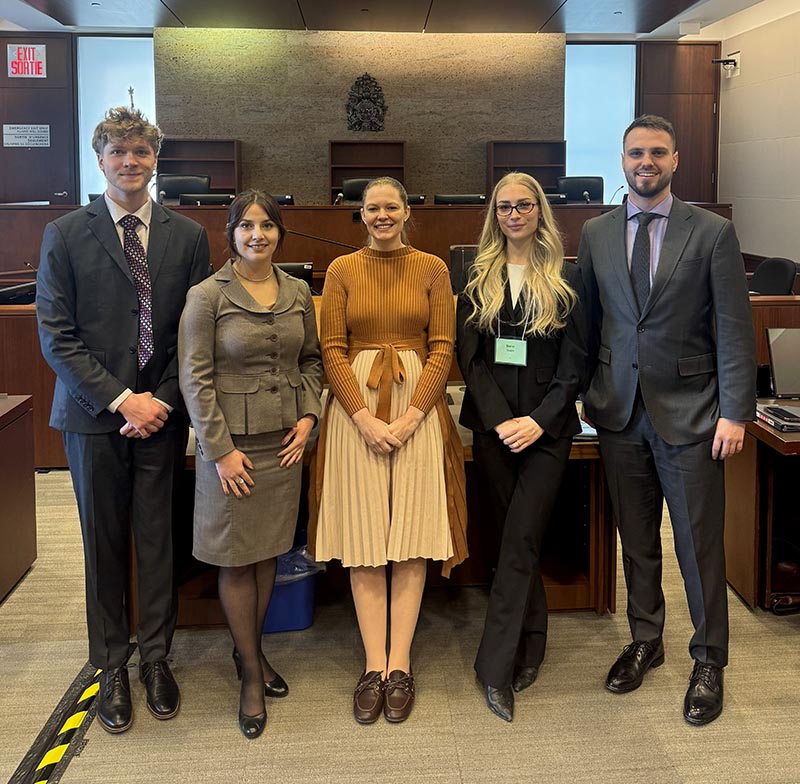
In his third and final year at USask Law, Heskin successfully tried out for one of the college’s moot teams. A mooting competition simulates a court hearing, with students analyzing, researching, and preparing arguments in connection with a problem, or hypothetical case. Each year, USask Law students and their coaches travel to compete in-person at approximately 10 different national mooting competitions.
Heskin was on the four-person team competing in the Laskin Moot. Named for the late Chief Justice Bora Laskin, it focuses on constitutional and administrative law, the latter being the branch of law that governs the activities of government agencies.
This year’s problem centred on a fictional case involving provision of Indigenous language education.
“It was by far the best experience in law school, getting to work on that team, slaving away on that problem,” said Heskin, who appreciated the process of gaining confidence during preparations for the competition.
“To see how nervous you were in practice with no stakes, to actually competing in front of real judges and being a little less nervous, was a really valuable and amazing experience.”
At the Laskin competition in Toronto, competing against students from 20 other law schools across Canada, Heskin tied for fifth-place oralist, a result he says was “really not too bad.”
He is now an articling student at MLT Aikins LLP in Saskatoon.
It was while working as a summer student at the firm after his first year of law school that he discovered the areas of law that genuinely captured his interest: labour and employment law, as well as administrative law.
“I just happened to get a few assignments in those practice areas and I really enjoyed the work. It was interesting and topical.”
He looks forward to a career in litigation, and said he will appreciate that every day will bring different challenges from his clients.
“Maybe it’s a problem you’ve handled before, but oftentimes it’s going to be novel, so you’re going to have to figure out something new and I look forward to that a lot.”