
Building a more people-centred justice system: CREATE Justice's growing national role
Saskatchewan is taking a leadership role in national access to justice initiatives
Efforts to make Canada’s justice system more accessible and responsive are gaining momentum nationally, with Saskatchewan represented strongly in this work.
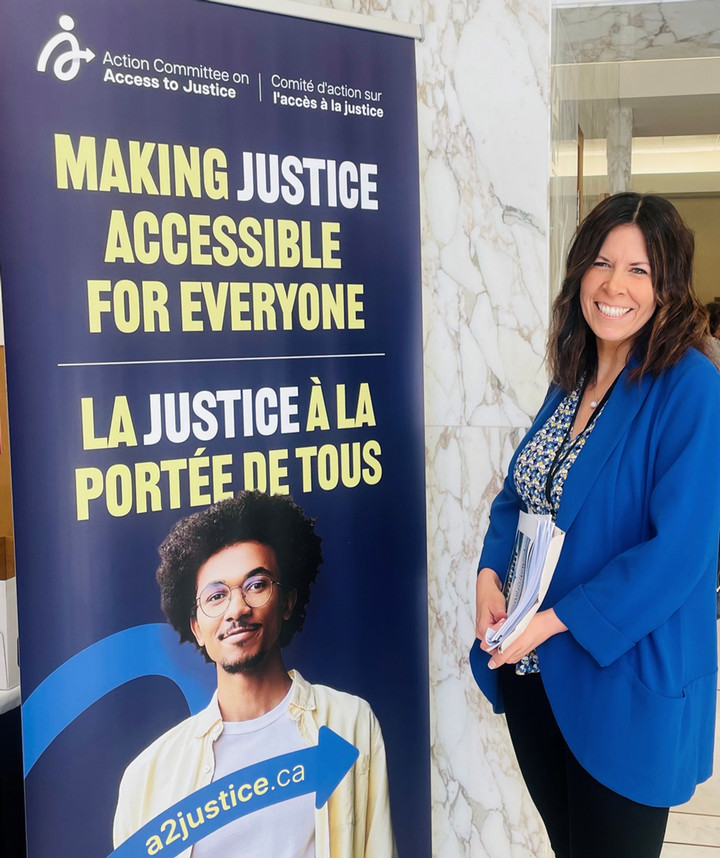
“What we are seeing now is a shift from isolated efforts toward a more connected, collaborative movement,” said Brea Lowenberger, director of CREATE Justice at the University of Saskatchewan College of Law and strategic advisor to the National Action Committee on Access to Justice.
“The real opportunity lies in how we bring together data, lived experience, and shared leadership to move from ideas into sustained action – so that access to justice is not just a goal, but a reality for people across Canada,” she added.
Over the past year, CREATE Justice has contributed to the Action Committee’s priorities by advising on key initiatives and supporting engagements like the Advancing People-Centred Justice in Canada conference held in Ottawa in May. Justice leaders, community organizations, and researchers from across the country attended.
In her opening remarks at the event, Supreme Court of Canada Justice Andromache Karakatsanis, Chair of the National Action Committee on Access to Justice, described how an inaccessible justice system is harmful.
“Unresolved legal problems are linked to serious social consequences – financial hardship, health challenges, and prolonged instability.”
Solutions must reflect the experiences of those using the system and be based on evidence and outcomes, she said.
“But major barriers remain: rising costs and delays, fragmented and confusing pathways, digital and cultural barriers, widening inequities, and declining trust in public institutions. The paradigm shift towards people-centred justice has begun, but its implementation is inconsistent and incomplete.”
After consulting with people from across Canada over the past two years, the National Action Committee is exploring the idea of justice as a common good, as essential public infrastructure.
“Before the adoption of universal public healthcare in Canada, many people could not access basic care because they could not afford it. Over time, Canadians came to understand healthcare as something fundamental — a collective good necessary for a healthy society, a healthy economy,” Karakatsanis said.
“Recognizing justice as a common good asks us to see justice differently. Not only as help for individuals in moments of crisis, but as a shared system that benefits everyone.”
Significant Saskatchewan contributions at national conference
At the May conference Saskatchewan’s representation was strong through a variety of sessions:
-
Re‑Engineering Professional Roles and Regulation for a Learning Justice System
-
Max Bilson, KC (Deputy Minister of Justice, Government of Saskatchewan) and Pamela Kovacs (Senior Policy Counsel, Law Society of Saskatchewan) shared insights on limited licensing and evolving professional roles.
-
-
Law Reform and Access to Justice in a People‑Centred Justice System
-
Leah Howie (Director, Law Reform Commission of Saskatchewan) co‑moderated this session, highlighting the role of law reform in advancing people‑centred justice.
-
-
Workshop: The Architecture of Change: Building Systems that Learn and Adapt
-
Brea Lowenberger (moderator) and Leah Howie contributed to this interactive session on system innovation and transformation.
-
-
Workshop: Progress Over Perfection: Works‑in‑Progress in Person‑Centred Justice”
-
Leah Howie and Brea Lowenberger facilitated this session, creating space for emerging ideas and collaborative learning.
-
Lowenberger bridging national and provincial efforts
-
Since beginning her national role with the Action Committee in July 2025, Lowenberger has contributed to key convenings and system innovation discussions, helping to bridge provincial and national efforts and strengthen alignment across jurisdictions.
-
CREATE Justice, which celebrates its 10th anniversary later this year, continues to coordinate and strengthen several interconnected initiatives, including the connection between the national PT Collaborative Working Group and the SK A2J Network: aligning stakeholders and translating knowledge into action across regions and sectors.
-
CREATE Justice is also contributing to the development of a broader national vision and supporting planning for an upcoming Action Committee summit aimed at aligning efforts and accelerating impact across the country.
-
The recently released Provincial-Territorial (PT) Collaboratives report highlights the critical role of collaboratives - such as the Saskatchewan Access to Justice (SK A2J) Network - as essential infrastructure for advancing access to justice.