
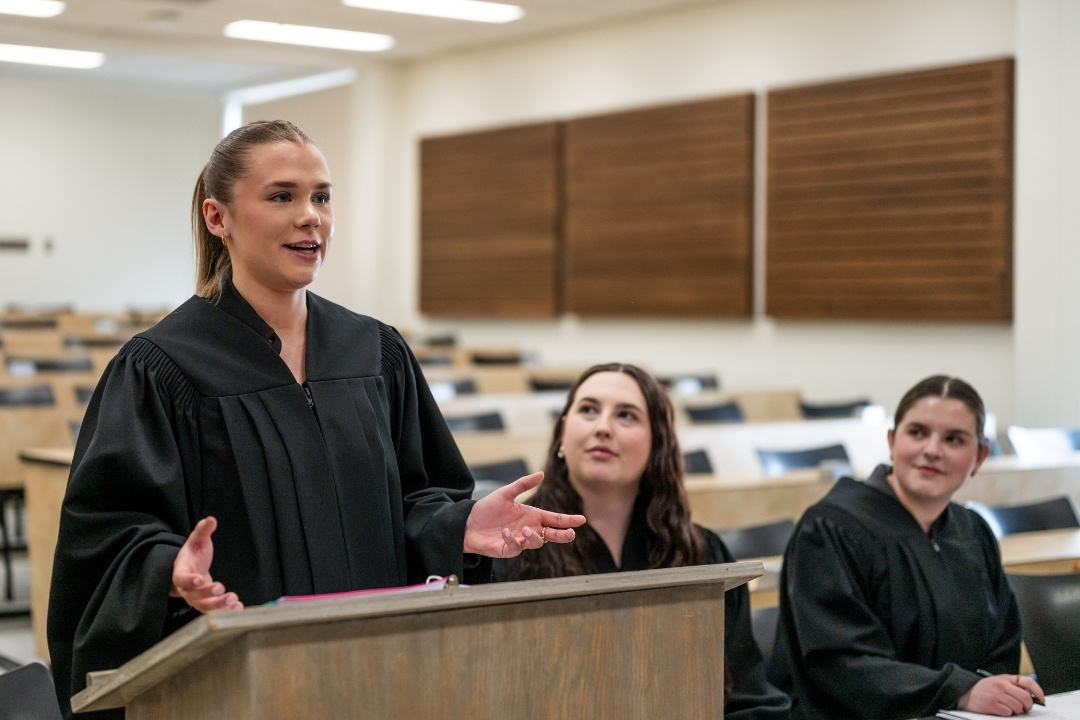
First-Year Moots: A USask Law tradition and triumph
The University of Saskatchewan (USask) College of Law holds an annual moot for its first-year students, providing them with an opportunity to test their oral advocacy skills.
By Amy LiebaertDressed in black robes and nervously reviewing their notes, first-year law students at the University of Saskatchewan become easy to spot in late February. The first-year moots, held annually as part of the Legal Research and Writing class, mark students’ first exposure to practising oral advocacy in a mock court setting. It is an exciting moment, but also one filled with nerves.
“Are you okay?” one student asks their partner minutes before their moot is scheduled to begin. “No!” she responds.
Students, in groups of two, prepare in advance for the moot as either the respondent or appellant. This year’s case focused on property law.
“Preparing for the moots is quite daunting for many of the students,” said Funmi Abioye, professor and organizer of the first-year moots, along with co-instructor Andy Chiang. “For some of our students, it’s their first experience of public speaking, and definitely oral advocacy. For others, they may have had some previous experiences of public speaking, but oral advocacy requires not just the ability to speak publicly, but the ability to marshal one's thoughts and present them while speaking.”
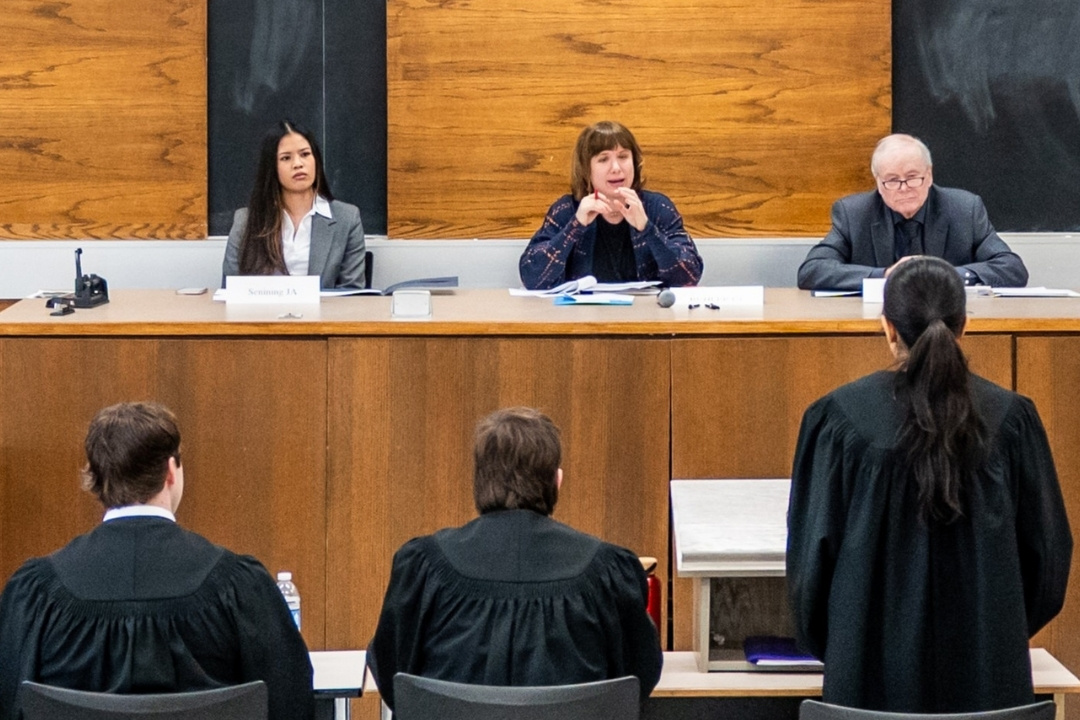
The first-year moots are more than a critical learning experience; they bring together the legal community, from upper-year students to faculty to college alum. When the call for alumni judges goes out, there is often a waitlist to volunteer, and this year, the available spots were filled the same day they were announced. Alumni are not returning simply to relive their student days. They are eager to give back to those walking in their shoes, supporting what many consider an invaluable law school experience.
Retired Provincial Court Judge David Kaiser (LLB’75) shared, “It was my first taste of being in a courtroom environment, and somehow it took root for me. It may well have led to the career I have enjoyed in the later part of my life.”
This experience is not uncommon for USask Law alum. “I remember well my first year and Jessup moots as valuable experiences during my time at the college,” said Bob Kirkpatrick (LLB’87), sessional lecturer and practising lawyer, referring to both the first-year moot and the international moot competition for upper-years students. “The work, preparation and effort put into the moots by the students is always inspiring and great to see.”
Including alumni judges is a purposeful choice, and necessary for effective learning. They provide feedback based on real-life experiences from their practices, which for students is often something more than a textbook can offer.
“First-year moots represent one of the first opportunities that students receive to practise aspects of the profession,” said Brenden Prokopchuk (JD’19), family law screening officer at the Saskatchewan Court of King’s Bench. “It creates an opportunity for those entering the legal profession to interact with those currently practising, which is beneficial for both the students and the lawyers."
During the moot, students have just fifteen minutes each for their arguments, and for answering questions from a judging panel composed of a faculty member, law alum, and upper-year student. Once arguments close, the judges leave the bench, as in formal courtroom settings, and then re-enter to give feedback to each mooter.
“A moot court is actually the safest place to make mistakes, and to correct them. The whole point of a moot is not perfection, but a honing of skills,” said Abioye.
Feedback focuses on the structure, clarity, and delivery of arguments: pacing, filler words, eye contact. All moots are recorded and later reviewed one-on-one between students and their professor to support improvement.

Each year, one exemplary student is presented with the Outstanding Mooter Award for excellent oral advocacy and participation. Brody Burr received the award for this 2025/26 set.
“I was truly honoured and grateful to receive the Outstanding Mooter Award,” said Burr.
Although his advocacy was strong, Burr said he did not escape the nerves of the day. “Before the moot, I was slightly anxious but tried to treat it as a theatre performance like I had done in the past, which allowed me to calm my nerves and channel precisely my arguments of what I wanted to present to the judges.”
Overall, he was grateful for the opportunity to practise a key courtroom skill. “It is hands-on experiences like these that I think are truly valuable for preparing us for the future of lawyering, and a great chance to experiment with oral argumentation.”